Showing posts with label Reverse Engineering. Show all posts

Pwn2Own hacker: Apple Safari is 'easy pickings'

Charlie Miller, the security researcher who won last year’s Pwn2Own hacker contest, is predicting that Apple’s Safari browser will be the easiest target this year.

In a note posted on the popular Daily Dave mailing list, Miller describes Safari as “easy pickin’s” and forecasts that at least four zero-day Safari flaws will be used during the contest at CanSecWest later this month.

[ SEE: Pwn2Own hacker contest targets browsers, smart phones ]

This year’s contest will pit hackers against browsers and smart phones with Internet Explorer, Firefox, Safari, Opera and Chrome among the high-profile targets. It will also include attacks against fully patched BlackBerry, Android, iPhone, Symbian and Windows Mobile phones in their default configurations.

Here are Miller’s predictions:

  • Safari: hacked by 4 different people. Easy pickin’s as usual.
  • Android: hacked by 1 person. Not too tough but no one owns one.
  • IE8, Firefox: Survive unscathed. The bugs to exploit equation is too hard for $5k.
  • iPhone, Symbian: Survive due to non-executable heap.
  • Blackberry, Windows Mobile, Chrome: I don’t know enough to say anything intelligent. That said, they’re probably hard/obscure and so survive.

Last year, Miller exploited a Safari flaw to hijack a fully patched MacBook Pro machine. He is also known for launching successful attacks against Apple’s iPhone and Google’s Android platform.

ALSO SEE: 10 questions for MacBook hacker Dino Dai Zovi

[Source: zdnet]

Oracle drops critical database server patch bundle

Oracle has dropped the first quarterly critical patch update for 2009 — with patches for 41 vulnerabilities in a wide range of database server products.

The January 2009 CPU includes 20 new security fixes for the company’s flagship database product lines, 4 new security fixes for the Oracle Application Server, 9 vulnerabilities in Oracle Secure Backup, 4 new security fixes for the Oracle Applications Suite, and 6 new security fixes for the PeopleSoft and JDEdwards Suite.

On the Oracle Database side, here’s a breakdown of the main patches:

  • 10 new security fixes for the Oracle Database. None of these vulnerabilities may be remotely exploitable without authentication, i.e. may be exploited over a network without the need for a username and password. 2 of these fixes are applicable to client-only installations, i.e. installations that do not have an Oracle Database installed.
  • 9 new security fixes for the Oracle Secure Backup product. All of these vulnerabilities may be remotely exploitable without authentication, i.e. may be exploited over a network without the need for a username and password.
  • 1 new security fix for the Oracle TimesTen Data Server. This vulnerability is remotely exploitable without authentication, i.e. may be exploited over a network without the need for a username and password.

According to Alexander Kornbrust from Red Database Security, the most critical bug could allow any user with execute privileges on dbms_ijob (e.g. DBA or hacker/user with DBA privs) to bypass Oracle Auditing completely.

This means no traces in the AUD$ and/or the operating system! All databases are affected.

Risk matrix definitions, including CVSS scores for all the vulnerabilities, are included in Oracle’s advisory.

* Image source: Oracle Security at Amazon.com.

[Source: zdnet]


Oracle planning Patch Tuesday whopper

Oracle plans monster patch dayMicrosoft may be offering a Patch Tuesday respite this month but, if you’re an Oracle database administrator, January 13 will be a very busy day.

The database server giant announced plans for a monster Patch Day next Tuesday with fixes for 41 security vulnerabilities in “across hundreds of Oracle products.”

The first CPU (Critical Patch Update) for 2009 includes patches for flaws that affect multiple products, the company said. “Due to the threat posed by a successful attack, Oracle strongly recommends that customers apply Critical Patch Update fixes as soon as possible.”

The following products are affected:

[ SEE: Microsoft planning quiet Patch Tuesday (1 critical) ]

  • Oracle Database 11g, version 11.1.0.6
  • Oracle Database 10g Release 2, versions 10.2.0.2, 10.2.0.3, 10.2.0.4
  • Oracle Database 10g, version 10.1.0.5
  • Oracle Database 9i Release 2, versions 9.2.0.8, 9.2.0.8DV
  • Oracle Secure Backup version 10.2.0.2, 10.2.0.3
  • Oracle Secure Backup version 10.1.0.1, 10.1.0.2, 10.1.0.3
  • Oracle TimesTen In-Memory Database version 7.0.5.1.0, 7.0.5.2.0, 7.0.5.3.0, 7.0.5.4.0
  • Oracle Application Server 10g Release 3 (10.1.3), version 10.1.3.3.0
  • Oracle Application Server 10g Release 2 (10.1.2), versions 10.1.2.2.0, 10.1.2.3.0
  • Oracle Collaboration Suite 10g, version 10.1.2
  • Oracle E-Business Suite Release 12, version 12.0.6
  • Oracle E-Business Suite Release 11i, version 11.5.10.2
  • Oracle Enterprise Manager Grid Control 10g Release 4, version 10.2.0.4
  • PeopleSoft Enterprise HRMS versions 8.9, 9.0 and 9.1
  • JD Edwards Tools version 8.97
  • Oracle WebLogic Server (formerly BEA WebLogic Server) 10.0 released through MP1, 10.3 GA
  • Oracle WebLogic Server (formerly BEA WebLogic Server) 9.0 GA, 9.1 GA, 9.2 released through MP3
  • Oracle WebLogic Server (formerly BEA WebLogic Server) 8.1 released through SP6
  • Oracle WebLogic Server (formerly BEA WebLogic Server) 7.0 released through SP7
  • Oracle WebLogic Portal (formerly BEA WebLogic Portal) 10.0 released through MP1, 10.2 GA, 10.3 GA
  • Oracle WebLogic Portal (formerly BEA WebLogic Portal) 9.2 released through MP3
  • Oracle WebLogic Portal (formerly BEA WebLogic Portal) 8.1 released through SP6

Additional details, including CVSS scores and affected components can be found in Oracle’s advance notice.

[Source: zdnet]

Apple looking to hire iPhone hacker

Apple looking to hire iPhone hacker Apple is in the market for someone capable of hacking into the iPhone.
According to this job listing, the company is looking for an iPhone Security Engineer capable of, among other things, developing “proof of concept” attacks on the device’s current security mechanisms.

The successful candidate will be tasked primarily with validating the security architecture for the iPhone.

Some responsibilities:

  • Review and provide feedback on security mechanisms implemented in OS X
  • Provide risk analysis of potential security threats to our embedded products
  • Develop “proof of concept” attacks on the current security mechanisms
  • Come up with new and innovative ways of increasing security while preserving ease-of-use and increasing the quality of the end-user experience.
  • Work cooperatively with other parts of CoreOS on cross-functional technologies and initiatives to enhance security and security policies

[ SEE: Apple caught neglecting iPhone security ]

This moves comes amidst news that the latest versions of iPhone are vulnerable to vulnerabilities that could aid phishing and spamming attacks.

Apple has also been criticized in the past for inordinate delays in shipping iPhone patches, a problem caused mostly because Apple’s agreement with carriers require every minor release is reviewed and approved, a mind-numbingly slow/exhaustive process.

* Photo credit: quinn.anya’s Flickr photostream (Creative Commons 2.0)

[Source: zdnet]

IDA Disassembler on the iPhone? Yep.

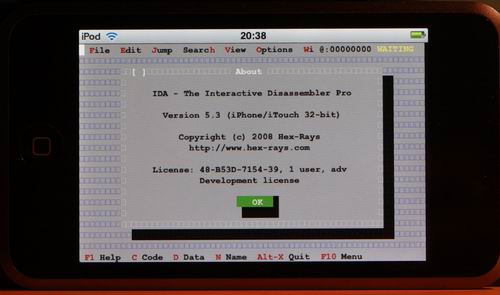
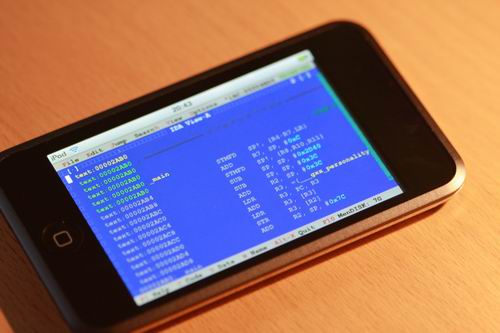
Ilfak Guilfanov has reported that IDA has been ported to the iPhone. Unbelievable? Yes. Is it useful? Who cares! IDA on the iPhone is hot!

Don’t act like you don’t want IDA for your iPhone, you know you do.

From the “Hex Blog”:

Good news for real iPhone fans: we ported IDA to iPhone! It can handle any application and provides the same analysis as on other platforms. It is funny to see IDA on a such small device:

Ilfak says only the heartiest of researchers and iPhone fans will use it as the interface is clumsy and done through terminal emulation. Here’s a shot from Ilfak’s blog on the tool actually running on the phone:

All I can ask is that this soon be sent to the Apple App Store or linked to in some other way, it will be the first thing I put on my new iPhone.

To Ilfak, well done, you’ve made my Friday!

[All images courtesy of Ilfak’s blog]

[Source: zdnet]

Has Halvar figured out super-secret DNS vulnerability?

Thomas Dullien Halvar Flake[ UPDATE: Kaminsky has all but confirmed that, yes, the cat is out of the bag ]

It looks very much like the nitty gritty of Dan Kaminsky’s super-secret — and heavily hyped — DNS cache poisoning vulnerability has been figured out by reverse engineering guru Halvar Flake.

Clearly irked by a demand request from Kaminsky and others to avoid speculating on the details of the flaw until the patch is fully deployed, Flake (left) published a reliable method to forge and poison DNS lookups.

Flake, CEO and head of research at Sabre Security, said his speculation was driven by the need to discuss the vulnerability in public instead of a one-month embargo that culminates with Kaminsky’s presentation at the upcoming Black Hat conference.

[ SEE: Dan Kaminsky breaks DNS, massive multi-vendor patch coming ]

“In a strange way, if nobody speculates publicly, we are pulling wool over the eyes of the general public, and ourselves,” Flake argued, before posting the following hypothesis:

Mallory wants to poison DNS lookups on server ns.polya.com for the domain www.gmx.net. The nameserver for gmx.net is ns.gmx.net. Mallory’s IP is 244.244.244.244.

Mallory begins to send bogus requests for www.ulam00001.com, www.ulam00002.com … to ns.polya.com.

ns.polya.com doesn’t have these requests cached, so it asks a root server “where can I find the .com NS?” It then receives a referral to the .com NS. It asks the nameserver for .com where to find the nameserver for ulam00001.com, ulam00002.com etc.

Mallory spoofs referrals claiming to come from the .com nameserver to ns.polya.com. In these referrals, it says that the nameserver responsible for ulamYYYYY.com is a server called ns.gmx.net and that this server is located at 244.244.244.244. Also, the time to live of this referral is … long …

Now eventually, Mallory will get one such referral spoofed right, e.g. the TXID etc. will be guessed properly.

ns.polya.com will then cache that ns.gmx.net can be found at … 244.244.244.244. Yay.

After the publication of Flake’s summation, Kaminsky gave a no-comment to The Register’s Dan Goodin.

Nate Lawson, head of Root Labs, had this to say: “It’s very plausible; I think he’s nailed it.”

[ SEE: Kaminsky and Ptacek comment on DNS flaw ]

Goodin, one of the more thorough security writers around, made a great point that if Flake’s speculation is unrelated to Kaminsky’s earlier discovery, then there are now two separate issues at play. Only one of the two has been patched!

Perhaps it’s time for Kaminsky to throw his self-imposed embargo out the window and help all of us understand the true severity of this vulnerability.

[Source: zdnet]

Protocol handlers cause Mozilla Firefox 3 remote command execution vulnerabilities

Billy RiosUpdate 07/16/2008: Apparently I neglected to mention that this has been patched already. Reading over it again and a heads up from a reader pointed out the error to me. As always, great job by Window Snyder and the Mozilla Security Team for getting this patched quickly.

Billy Rios is at it again. Rios, Rob Carter, and I have made a year and more of our research into exploiting URI/protocol handler vulnerabilities on numerous operating systems and applications, and it appears Rios has ANOTHER one to go with all that previously reported, as well as his most recent vector, which was used against Opera.

From Mozilla:

Security researcher Billy Rios reported that if Firefox is not already running, passing it a command-line URI with pipe (”|”) symbols will open multiple tabs. This URI splitting could be used to launch chrome: URIs from the command-line, a partial bypass of the fix for MFSA 2005-53 which was intended to block external applications from loading such URIs (that vulnerability remains fixed, however).

This vulnerability could also be used by an attacker to pass URIs to Firefox that would normally be handled by a vector application by appending it to a URI not handled by the vector application. For example, web browsers normally handle file: URIs themselves, or block them from web content altogether, but this flaw enabled attackers to pass them from another browser into Firefox. In Firefox 2 scripts running from file: URIs can read data from a user’s entire disk, a risk if the attacker could first place a malicious file in a guessable location on the local disk. Rios demonstrated that the so-called “Safari Carpet-bombing vulnerability” could be used for this, as well as other techniques that do not rely on that now-fixed Safari vulnerability.

In Firefox 3 scripts running in local files have limited access to other files, almost entirely mitigating the file: attack. However, combined with a vulnerability which allows an attacker to inject script into a chrome document the above issue could be used to run arbitrary code on a victim’s computer. Such a chrome injection vulnerability was discovered in Firefox 3 by Mozilla developers Ben Turner and Dan Veditz who showed that a XUL based error page was not properly sanitizing inputs and could be used in this attack. In the absence of the attack described by Billy Rios this injection attack would not run with any special privilege and would be at best a spoofing vulnerability.

It will be interesting to see if Rios provides proof of concept code, but if you look at the protocol handler registered on the operating system, and how it interacts with Firefox, it may be straightforward. URI and protocol handler abuse continues to be an extremely viable option of attack.


[Source: zdnet]